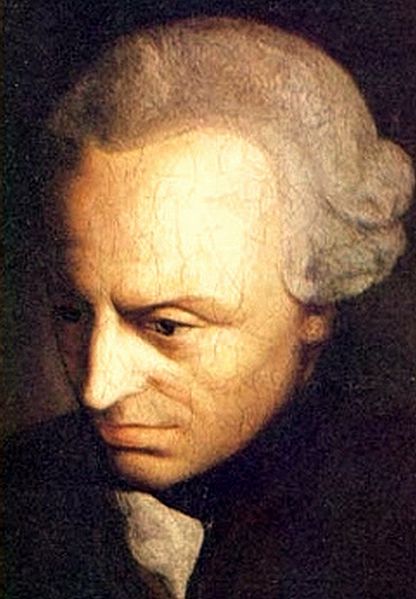
Kant, Immanuel (1724 to 1804)
I am not an expert in Kant, but I confess that I have in Marbella, as a summer reading, an old copy edited by Bergua in 1934 of the Critique of pure reason with the Prolegomena included. The elaborated prose of D. Inmanuel, translated by D. Manuel Fernández Núñez, almost allows to “see” how his brain works, passionately trying to transfer his thoughts to paper.
But at first I did not see anything in it that had a significant relationship with my ideas. I looked at his categorical imperative and it seemed to me a serious attempt to find the basis or a foundation of morality, that is, the objective or purpose to be achieved by Man and the way for trying so. But his categorical imperative, in its various versions, was empty. Like the virtues of Aristotle, the imperative was left to the will of reason, the criterion and the good will of each man.
In April 2015 I happened to find a little book entitled “Philosophy of history” (Kant: 1941) that collects five brief essays written between 1784 and 1794 (his 60 and 70 years), which have no waste for our matters. Then I read carefully his Groundwork of the Metaphysics of Morals and I reviewed some other less close texts. I summarize the most significant ideas:
In “Idea for a Universal History with a Cosmopolitan Aim“, Of 1784, writes that” …human actions are determined, as are the other natural phenomena, by the general laws of Nature” And he says later: “Men do not imagine …that by pursuing their purpose, they follow …the intention of Nature” He confesses that he does not know what this intention is and instructs the philosophers to try to discover it. And asks Nature: “That brings us the man who wants to conceive it, …that’s how he produced a Kepler and a Newton”.
With the above it seems that he admits the existence of natural laws that determine human actions, but as clarified in the prologue of the Groundwork, there are two types of laws. He says: “Because the laws are, either laws of nature or laws of freedom. The science of the first ones was called physical; the one of the second ones, ethics”. And for Kant, what counts for man is the non-physical: it is ethics, based on the freedom of the spirit.
Throughout the text of the Groundwork he makes clear that the foundation of moral obligations or laws: “…should not be sought in the nature of man or in , circumstances of the universe in which man is placed, but a priori in concepts of the pure reason …” (389). I suppose that to avoid problems he does not mention God, but the idea is clear: man is self-sufficient in these matters. And then in (432), speaking of the failures to discover the principles of morality, he says: …The man was seen bounded by his duty to laws: but no one got to think that he was subject to his own legislation, although this is universal, and that he was obliged only to act in accordance with his own legislative will “. Moral autonomy vs heteronomy.
He has another problem, like many others, with the subject. In the second principle of the “Idea of a universal story… ” He says: In men (as the only rational creatures on the earth) those natural dispositions, which point to the use of their reason, must be developed completely in the species and not in the individuals. It seems that here he considers the species as something where things can develop. And in all texts he uses the term species; and that of man as a synonym of species or of Man. In many places it seems that tacitly or expressly uses the concept of species. With different meanings as usual.
However, as a philosopher, Kant does not see or does not like to make explicit that the species can be the subject to something. And in the essay entitled “Conjectural Beginning of Human History” clarifies that it does not refer to the human race “…according to the concept of the species (singulorum) but according to the totality of the men reunited socially on Earth, distributed by towns (universorum)”.
On the other hand, neither he is worried about the survival of Man, since in the third principle of “Idea of a universal history…” considering the perfection and happiness that man, free of instinct, procures for his own reason, he says: “…if one animal species is endowed with reason, as an all mortal rational beings class, but whose species is immortal, must reach the perfection of the development of its dispositions. “
Kant’s aim is always spiritual. In “The alleged beginning of human history“, Of 1786 highlights that: “…destiny of the species does not consist in anything else but in progressing towards perfection”. But progress is not material. In “If the human gender is in constant progress towards better”, of 1798, defining the eudemonism or quiliasmo, says that this is when the human race is… “in constant progress towards better in regard to his moral destiny. “
In these “minor” works Kant reflects an enormous sensitivity to the problems of men. I would recommend to those who do not know him to read this small book of 147 pages, entitled Philosophy of history, edited by the mexican Fondo de Cultura Económica. You will discover an endearing Kant.
Kant got it right with the categorical imperative, with his good will and his eudemonia, but all of them are vague and ineffective concepts for operational purposes. I think it happened to him as to many other philosophers. The “natural” objectives -survival, material wellness- seem insufficient to them: animal things. And as they take the perennial existence of men for granted, they do not think how difficult it is to survive. And that all virtues, intelligence, morality… are, in principle and for what we know so far, means and strategies for that vital and primary purpose of surviving.
I believe that Kant, with his good will and his extraordinary intelligence, is the main cause by which the Illustrated and his followers did not see, nor have seen, the elemental, natural and obvious basic idea: the vital imperative or the law of survival of the species, including ours.
Marbella, 30.8.2018. Revised on 1.10.18