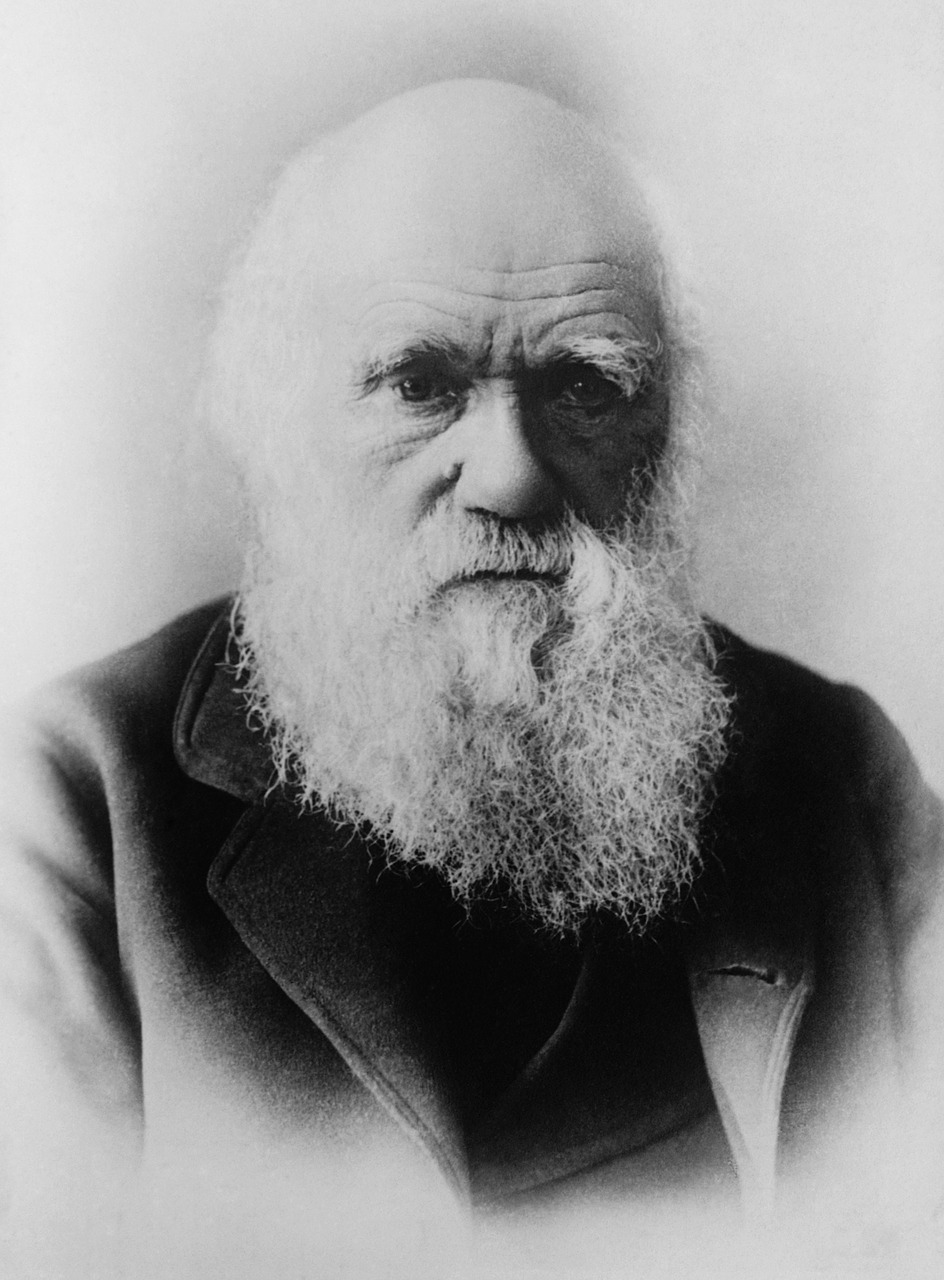
Charles Darwin ( 1809-1882)
I confess that I have not read The origin of species completely. I have only used it as a reference book for some specific aspects. I met the theories of Darwin and his followers and detractors by other books. From these readings it seemed to me that Darwin was not concerned about the initial or final causes of speciation. I think he looked and described very well what living beings had done and did to adapt to the environment. But he assumed that it was to survive, everyone, without specifying.
For Darwin, despite what the title of his most famous book suggests, the subjects who lived and evolved were individual organisms. The species were the result of the evolution of organisms. Which is true. But it is also true that species are, as concrete sets, and different in each moment, which, through their organisms, evolve. But in this and its consequences, Darwin did not repair. And for that reason I did not include it in the comments to other people’s texts of my first book: The Universal Ethical Mandate. Ideas to contrast.
But in August 2015, motivated by the readings of Gould, Koprotkin and Hütner, I read the first seven chapters of “The origin of the man” And I discovered another Darwin whose ideas I commented extensively on Supervivir (Corral: 2015, 273-280).
The Darwin that I thought I knew was the father of the theory of evolution. Theory that he had discovered by studying the physical characters (peaks, feathers, shells…) of the individual organisms of different species. Whose main strategy was the struggle for existence and the dominion of the strongest or fittest. In other words, it seemed to preach selfishness and competition as means to survive. Which are certain means in general. But in the case of man, not the only ones or the main ones. Darwin says:
“In its most imperfect current state, man is always the most dominant animal of all those who have appeared on the surface of the earth …This immense superiority undoubtedly owes it to his faculties, to his social habits, which lead him to help and defend his peers, and the characteristic conformation of his body …The supreme importance of these characters has been demonstrated in the final result of the struggle for existence”.
In “The origin of species” Darwin hardly talks about man. And still he had the problems he had: on the part of his detractors, drawing him with the body of a monkey and his supporters who wanted to improve Man through eugenics. I think that for both, and especially for the latter, he had to write, twelve years later, the first part of “The origin of the man”. Where he attaches much more importance to the spiritual and social than to the physical. Among other phrases in this sense he says later:
“For the higher animals with social instincts I do not know any structure (physical)that has been modified only for the good of the community, even though there are also some secondary usefulness […] With respect to some mental faculties… the case is completely different: because these faculties, in their great majority, and still almost in their totality, were acquired for the benefit of the community…”
“…if in its origin, man had been stronger and fierce, it is probable that this defect (sic) would have prevented him from acquiring mental qualities as superior as sympathy and love of neighbor”.
Note: Remember that the term “simpatía”, sympathy in English, as Darwin and others use it, means in this context: solidarity, compassion, kindness… Darwin says that the sympathy is the most important emotion. Only differentiates it of maternal love. And he highlights its value:
“…because the societies that had more sympathetic members would undoubtedly be the ones that would flourish the most, and, therefore, could raise more robust and abundant offspring”.
And in the general conclusions when speaking (a biologist) of the foundations of moral (sic), says:
“The term General Good can be defined by saying that it is the means of producing, within the existing conditions, the greatest number of individuals in full vigor and full health, endowed with faculties as perfect as possible…” “it would be desirable to be taken for norm of morality the general good or welfare of the community, with preference to the general happiness…” There is no doubt that the good and the happiness of the individual coincide frequently, and that a content and happy tribe prospers more than the unfortunate and miserable” .
Darwin, without realizing his importance, with these phrases is saying the basic idea: clearly makes the tribe subject, active and beneficiary, of the attempt to be prosperous and to produce happy individuals. And vice versa. And although he speaks of tribe here, he later says that there are customs and superstitions that are in complete opposition to “…welfare and happiness of humanity“. It seems clear that the welfare and happiness of humanity are the objectives to try to achieve. For what? To produce individuals in full vigor and full health. Namely to survive. And for this the means is to be sympathetic in English, that is: solidary, broad altruistic.
And it matches all atheistic moralists self-employed and within the Church, when he says “…man has means to distinguish higher moral standards from lower ones. The former are based on social instincts and refer to the welfare of others… The latter refer mainly to the individual himself “. He is right in what he says, although he does not realize, like many others, that the well-being of one and the others is the same. That’s what intelligent altruists / egoists know. The wise and holy, believers and non-believers.
And then Darwin, with his extraordinary capacity, anticipates the desirable future and says:
“As man advances on the path of civilization, and small tribes come together to form more numerous communities, simple reason dictates to each individual that he should extend his social instincts and his” sympathy” to all those who make the same nation up even if they are not personally known to oneself. Once this point is reached, there is already only an artificial barrier that prevents his sympathy from spreading to all men of all nations and all races.”
And since he was in an optimistic time that believed in enlightened progress, he says:
“Looking to future generations there is no reason to fear that the social instincts will weaken, and we can expect that the habits of virtue will be further strengthened and perhaps become fixed through inheritance. In this case the struggle between our superior and inferior impulses will be less strong and virtue will triumph. “
It does not seem like it’s that way. It seems that we have stayed in the area of individual and tribal welfare. We need to remove or tear down “the artificial barrier” If you give us time.
In summary and as I said in Survive, I think “The origin of species” Was the revelation of the theory of biological evolution, the first five chapters of “The origin of the man” Is the first scientific treatise biological/philosophical that, once interpreted, can establish the foundations of a moral “For all men of all nations and of all races.”
A pity that these ideas have not been seen before. Neither by his disciples nor by his detractors who have remained in the tasks, in the details, instead of seeing the vital objective. Surely because of the problems of specialization and tribalism.
Marbella, 13.9.2018. Revised on 5.10.18